Do Keto Gummies Actually Put You in Ketosis?

Do keto gummies put you into ketosis?
Not in the way the label implies. A keto gummy contains BHB salts that can nudge the ketone level in your blood upward for a few hours, but that is not the same as nutritional ketosis, which only happens when your body runs low on carbohydrate and starts burning its own fat for fuel.
- Exogenous BHB raises blood ketones temporarily; it does not switch on fat-burning.
- A ketone strip can read higher after a gummy without any dietary change at all.
- Real ketosis needs carbohydrate restriction — the gummy cannot do that job for you.
What "ketosis" actually means
Ketosis is a metabolic state, not a number on a strip. When carbohydrate intake drops far enough, your liver runs short of its usual glucose fuel and begins converting fatty acids into ketone bodies — acetoacetate, beta-hydroxybutyrate (BHB) and acetone. Your brain and muscles then run partly on those ketones. The important part is that the fat being broken down is your own. That internal production is what people mean when they say "fat-burning ketosis."
Getting there takes work your body has to do itself. It usually requires a day or more of keeping carbohydrate quite low — often under about 50 grams a day — so that insulin falls and stored glycogen is depleted (StatPearls, NCBI Bookshelf: The Ketogenic Diet). The trigger is a genuine shortage of carbohydrate fuel. Nothing about that process is started by swallowing a ketone.
What a keto gummy actually contains
Most keto gummies are built around exogenous BHB: beta-hydroxybutyrate bound to a mineral such as sodium, calcium or magnesium, usually alongside apple cider vinegar. "Exogenous" simply means "from outside the body." Instead of your liver making the ketone, you eat a ready-made one.
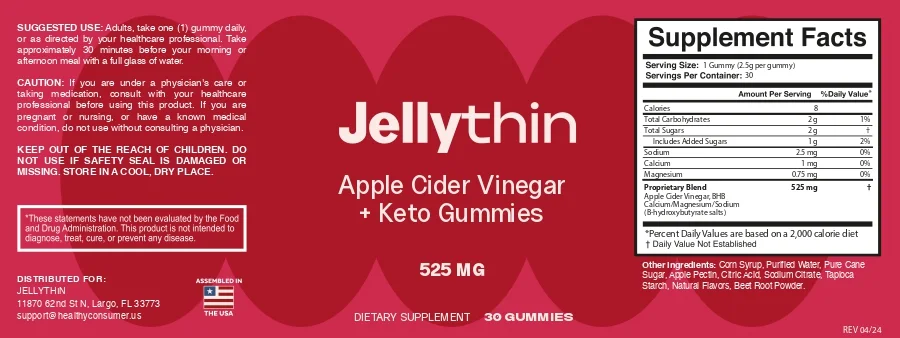
The quantities are the catch. As we work through in our label breakdown, a typical proprietary blend delivers ketone salts in the range of milligrams, while the research that meaningfully raises blood ketones uses roughly 10 to 12 grams per serving. That is a gap of more than two orders of magnitude. You can check the gap yourself with the arithmetic in how much BHB is in a keto gummy. So even the brief, expected rise in blood ketones is far smaller than the packaging implies.
Blood ketones vs metabolic ketosis: the gap the marketing lives in
Here is the sleight of hand. "Puts you in ketosis" and "raises blood ketones" sound like the same claim, but they describe two different things. Swallowing BHB does raise the concentration of BHB in your blood for a while — that is just what happens when you consume any substance and it enters circulation. But your body is not in ketosis in any meaningful metabolic sense: your insulin is not low, your glycogen stores are full, and you are burning the ketone you ate rather than the fat on your body.
If anything, exogenous ketones can slightly reduce your own ketone production through feedback, because the body senses ketone fuel is already available and has less reason to make more. So the gummy can raise a reading while nudging your internal fat-burning in the opposite direction. The distinction is unpacked in exogenous versus endogenous ketones.
A gummy can raise the ketone in your blood without your body burning a single gram of its own fat. The strip goes up; the mechanism the strip is supposed to prove does not.
What a ketone strip is really telling you
Blood and urine ketone tests measure ketone concentration, full stop. They cannot tell whether those ketones came from your fat cells or from a gummy you took twenty minutes ago. So a positive reading after taking exogenous BHB is entirely expected and proves nothing about dietary ketosis.
This matters because "look, my strip turned purple" is often offered as proof that a product works. All it demonstrates is that you consumed ketones, which was never in doubt. If you want to know whether you are actually in ketosis, you have to test in a fasted state, several hours away from any exogenous source, so the reading reflects what your own metabolism is producing.
How long the bump lasts
Studies of exogenous ketone salts and esters find blood BHB rises within about 30 to 60 minutes and drifts back toward baseline within a few hours, depending on the dose and whether it was taken with food (Newman & Verdin 2017, PubMed 28826372). With the milligram-scale doses in a gummy, any change is smaller and briefer still. It is a transient, not a switch: the moment the dose clears, you are metabolically exactly where you started.
Does raising blood ketones do anything useful?
Possibly, in narrow contexts. The research interest in exogenous ketones centres on endurance performance and a few specific clinical uses, at gram-scale doses, and even there the findings are mixed. What the evidence does not support is the idea that a small daily dose of exogenous BHB drives weight loss, forces fat-burning, or substitutes for the carbohydrate restriction that produces real ketosis (NCCIH: Weight Control and Dietary Supplements). If fat loss is your goal, the ketone you swallow is a sideshow next to the calorie deficit that actually moves the scale.
A fair way to think about a keto gummy
None of this makes the product a scam — it makes the name a marketing choice. A keto ACV gummy is really a low-dose apple cider vinegar supplement with a small amount of ketone salt attached, and it deserves to be judged on that basis: a convenient daily habit that can sit alongside an eating pattern you are already improving. That is also why you can sensibly take one without doing a keto diet at all. If your aim is to be in ketosis, the only lever that works is the food on your plate. The gummy will not pull it for you, no matter what colour the strip turns.
See the label this was written from
The full Supplement Facts transcription, the blend arithmetic and today's official-store pricing — on one page.
Get OfferFrequently asked questions
Do keto gummies put you into ketosis?
Not in the fat-burning sense. They add a small amount of ketone to your blood for a few hours, but they do not restrict carbohydrate or lower insulin, which is what actually triggers your body to burn its own fat for fuel.
Will a ketone test read positive after gummies?
It can. A blood or urine strip measures ketone concentration and cannot tell whether the ketones came from your fat or from a supplement, so a reading after taking exogenous BHB is expected and proves nothing about dietary ketosis.
Do I still need low carbs with keto gummies?
Yes, if genuine ketosis is your goal. Nutritional ketosis is driven by carbohydrate restriction, not by swallowing ketones, so a gummy cannot do that job for you whatever the front of the jar says.
How long do gummy ketones last?
Exogenous ketones typically rise within an hour and drift back toward baseline within a few hours. With the small milligram doses in a gummy, any bump is smaller and shorter, and you return to your starting point once it clears.
Related reading
- Exogenous vs endogenous ketones: a simple guide
- Can you take ACV gummies without a keto diet?
- ACV and Tooth Enamel: Gummies vs Liquid Safety
- How to read a keto gummy nutrition panel